7 Tips for Buying Fish Collagen Powder in Bulk
Buying Fish Collagen Powder in bulk can lower unit costs, but a low quote tells only part of the story. Buyers also need to assess raw-material origin, peptide specifications, testing, and delivery terms. A practical decision starts with documents, not promises.
The FAO’s State of World Fisheries and Aquaculture 2024 reported 185.4 million tonnes of aquatic animal production in 2022. About 89% was used for direct human consumption. These figures describe a vast, varied supply chain; they do not prove that suitable fish skins or scales are available for collagen production. That distinction matters. Ask suppliers to identify the species, processing location, and source of the collagen, then verify those details in current records.
Bulk purchases magnify small inconsistencies. A slightly different peptide profile, unclear test method, or damp sack can affect an entire shipment. It happens. Before committing, compare product specifications and recent certificates of analysis, and confirm testing for relevant contaminants with a qualified laboratory. Check batch traceability, packaging barriers, minimum order quantity, shelf life, and the full landed cost. Storage conditions deserve attention, too.
The seven tips that follow offer a framework for comparing suppliers without treating any single certificate as a guarantee. Some buyers may still overlook one detail. Recheck the assumptions before signing.
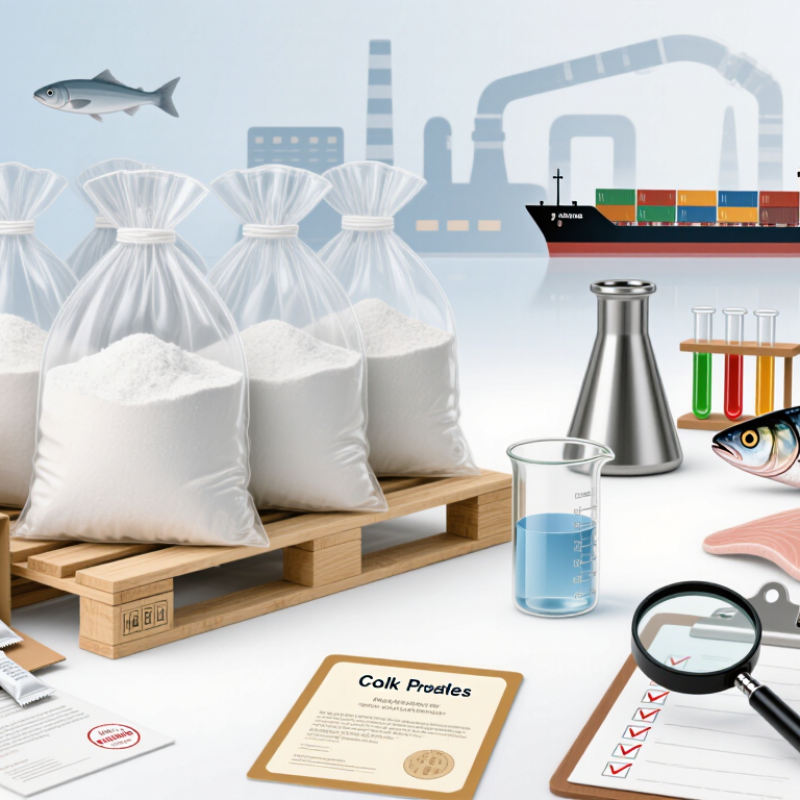
Clarify Your Intended Use and Required Collagen Specifications
Before requesting bulk quotes, define what the powder must do. Start with purpose. A drink mix may need a neutral taste and easy dispersibility, while capsules may place more emphasis on peptide concentration and particle size. For topical formulations, check that the supplier’s documentation supports the intended application; food-grade material is not automatically suitable for every use.
Then write down the specifications that matter. Confirm the fish source, collagen type, hydrolysis status, protein content, moisture range, and any stated peptide-size range. Ask for a recent certificate of analysis and review its test methods, batch number, microbiological results, and contaminant limits. Fish allergen controls matter too, especially if the finished product will be labeled for sensitive consumers. Request a sample and test it in your actual recipe. Check how it smells, mixes, and tastes after standing for several minutes. Small differences can matter. It is easy to overfocus on a headline protein percentage; solubility and flavor may be more important in daily use. Some specifications may need adjustment after trials, so record what worked and what did not before placing a large order.
Verify Fish Species, Sourcing, and Manufacturing Practices
For bulk fish collagen powder, ask for the fish’s common and scientific names, not just “marine collagen.” Species identity helps you assess allergen risks and compare suppliers accurately. Ask which parts are used, such as skin or scales, and whether the material comes from wild fisheries or aquaculture. Details matter.
The FAO’s The State of World Fisheries and Aquaculture 2024 reports 223.2 million tonnes of global fisheries and aquaculture production in 2022, including 185.4 million tonnes of aquatic animals. That scale makes clear sourcing records important.
Request the harvest area or farm location, processor details, and lot-level traceability documents. A broad country-of-origin statement is not enough. I would treat paperwork as a starting point, not proof.
Manufacturing checks matter too. Ask for batch-specific test reports covering identity, protein content, microbiological quality, and relevant contaminants. Confirm that testing was performed by a qualified independent laboratory, and review the methods and dates—not only the pass result. For hydrolyzed collagen, DNA testing of the finished powder may be less informative after processing; ask how species identity is verified in incoming raw material. Visit the facility if practical. Records can look tidy. Traceability still deserves a closer look.
Review Quality Testing, Certifications, and Regulatory Compliance
When buying fish collagen powder in bulk, request a certificate of analysis tied to the exact lot, not a generic product sheet. Check the test date, laboratory identity, and methods used. Results should cover relevant measures such as protein content, heavy metals, and microbiological quality. Ask whether the lab is independently accredited. Check the lot. A clean-looking powder proves very little.
Certifications can support confidence, but their scope matters. Confirm that the certificate is current and covers the actual facility and product, rather than a related site or process. Ask for audit details and verify documents directly with the issuing organization when possible. Keep the supplier’s answers on file. Paperwork matters. Still, a certificate is not a substitute for reviewing test results from the shipment you plan to buy.
Regulatory requirements differ across markets, so confirm which rules apply where the powder will be sold. Request species and source information, traceability records, and documentation for fish allergen labeling. Compare the shipped product’s label and specifications with the approved documents. If a supplier cannot explain a missing result, pause before placing a large order. I would also test a retained sample after delivery; it adds cost, but bulk mistakes are harder to correct. My own checklist can feel overly cautious, yet one vague document is enough to ask another question.
Compare Bulk Pricing, Packaging, and Supplier Terms
When buying fish collagen powder in bulk, compare the delivered cost per usable kilogram, not just the quoted price. Include freight, sample fees, pallet charges, and any payment or reorder conditions. Ask suppliers to state minimum order quantities, price breaks, lead times, and how long a quote remains valid. A low unit price can lose its appeal when the order arrives in oversized bags that are awkward to store.
Tip: Compare like with like. Request the same collagen form, source details, protein specification, moisture limit, and test documents from each supplier. FAO’s The State of World Fisheries and Aquaculture 2024 reports 185.4 million tonnes of aquatic animal production in 2022. That figure describes the wider seafood supply, not collagen availability, so it should not be treated as a price forecast. Check each lot’s certificate of analysis and traceability records.
Packaging matters. Ask whether inner liners protect powder from moisture, and confirm bag sizes, pallet configuration, and storage guidance. Get damaged-goods and short-shipment terms in writing. Also clarify whether the supplier can hold a specification across repeat orders; small changes can affect mixing or finished-product texture. I still find this easy to overlook: a cheaper bulk pack is not automatically easier to handle. Request a sample in the proposed packaging before committing to a large shipment.
