China Top 10 Red Light Therapy Face Devices for Buyers

Choosing among China’s top 10 red light therapy face devices takes more than comparing prices and glowing product photos. Buyers should check wavelength specifications, treatment area, eye-safety instructions, build quality, and whether the seller provides clear usage guidance. Small details matter: a mask’s fit around the nose, the weight on the cheeks, and the length of its power cord can shape everyday use.

The broader light-therapy market is tracked by commercial research firms, but estimates vary by report scope and category. Those figures should not be treated as sales data for face devices alone. Clinical research also needs careful reading. For example, Wunsch and Matuschka’s 2014 controlled study examined red and near-infrared light for skin appearance; it does not establish that every consumer device produces the same results. Red Light Treatment Face products differ in output, design, and testing, so buyers should look for device-specific evidence rather than broad claims.

Expert perspective matters, too. Michael R. Hamblin is a photobiomodulation researcher whose published work reviews possible mechanisms and applications of light-based treatments. I could not verify a reliable, attributable quotation from him specifically about consumer facial devices, so I will not invent one. That gap is worth noticing. This guide compares available product information and flags where evidence is limited, helping buyers ask better questions before choosing a device.
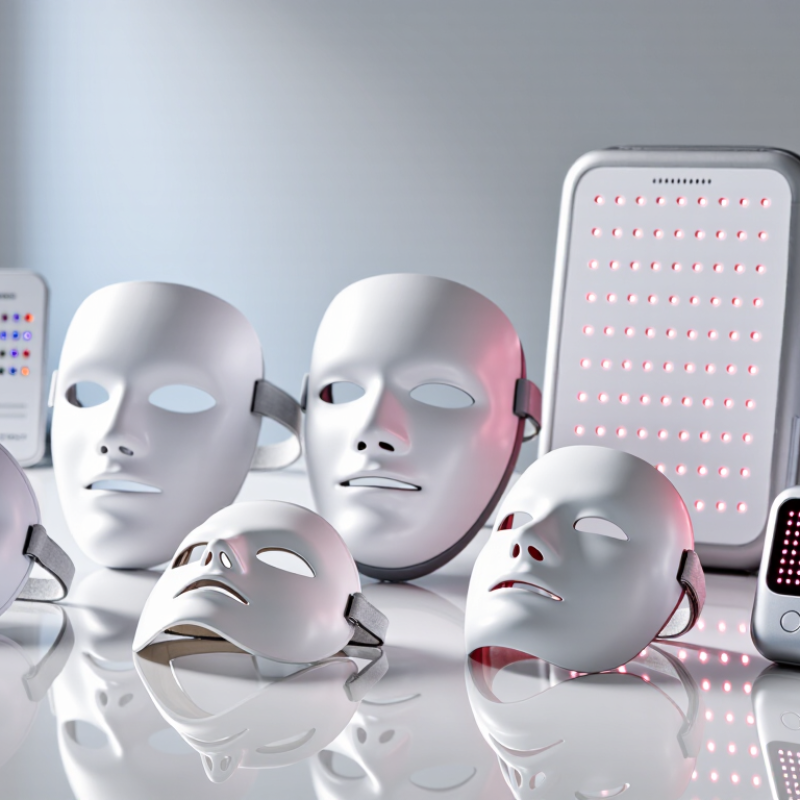
China Top 10 Red Light Therapy Face Devices for Buyers

Define Red-Light Face Therapy and Its 630–660 nm Wavelength Range

Red-light face therapy uses low-level visible light to deliver energy to skin without relying on ultraviolet rays. Face devices commonly use wavelengths from 630 to 660 nanometers. These wavelengths sit in the red portion of the spectrum, but the number alone does not predict results. Power output, treatment time, distance, and consistent use also matter. The mechanism is still being studied.

A controlled trial published in Photomedicine and Laser Surgery in 2014 enrolled 136 volunteers and assessed visible-light treatment for facial skin changes. Researchers measured outcomes including fine lines, skin roughness, and collagen density. That study offers useful context, not a guarantee: its protocol and device conditions may differ from home devices. Red light is not a shortcut, and wavelength claims deserve careful checking.

Tips: Check that a device clearly lists its wavelength and treatment instructions. Keep it at the stated distance, and protect your eyes as directed. A 630–660 nm label is a starting point, not proof of effectiveness. Evidence remains uneven. That matters.

Compare the Top 10 China-Made Devices by Wavelength and Irradiance (mW/cm²)

For buyers comparing China-made red light therapy face devices, wavelength and irradiance matter more than LED count alone. Many facial devices use red light near 630–660 nm, while some add near-infrared light around 810–850 nm. A clinical study by Lee et al. in the Journal of Photochemistry and Photobiology B (2007) examined 633 nm and 830 nm LED treatments for facial skin. These wavelengths are useful comparison points, not proof that every device produces the same results.

Check irradiance in mW/cm² at the stated treatment distance, not just at the LED surface. For example, a reading taken at contact may differ from one measured several centimeters away. Ask sellers for calibrated meter readings, test distance, and whether the figure is measured per wavelength or combined. Small details matter. A 2023 review by the U.S. National Center for Biotechnology Information notes that photobiomodulation outcomes depend on parameters such as wavelength, power density, and dose. Compare those details across the top ten listings, alongside coverage area and session time. Manufacturer data can be incomplete; that is a real limitation. I would treat unusually precise claims cautiously unless the test method and independent verification are provided.

Assess Treatment Dose in J/cm², Session Time, and Manufacturer Guidance

For buyers comparing China’s top ten red light therapy face devices, dose matters more than a bright panel. The Global Wellness Institute valued the global wellness economy at $5.6 trillion in 2022, expanding consumer choice without guaranteeing technical quality. Ask for wavelength, irradiance, treatment distance, and measured dose. Missing numbers are a warning.

Dose is expressed in joules per square centimeter (J/cm²). Calculate it by multiplying irradiance in W/cm² by seconds. A device delivering 30 mW/cm² for five minutes provides about 9 J/cm², before losses from distance or angle. World Association for Laser Therapy guidance commonly uses low-single-digit to approximately 10 J/cm² ranges, depending on the application. A 2023 review in Photodermatology, Photoimmunology & Photomedicine reported substantial variation between light-therapy protocols. More energy is not automatically better. It may be excessive.

Check whether the manufacturer states dose at the skin, not only LED power. Confirm session duration, eye-protection instructions, and testing procedures. Independent irradiance testing is preferable. Guidance should match the supplied distance; moving the device changes exposure. Keep a treatment log with dates, minutes, and skin responses. Results can be uneven. I would question listings promising identical outcomes for every face, because fit, pigmentation, sensitivity, and calibration differ.

China Top 10 Red Light Therapy Face Devices for Buyers

Assess treatment dose in J/cm², session time, and manufacturer guidance

The chart compares ten anonymized treatment profiles without displaying company or brand names. Dose is calculated using the standard relationship: Dose (J/cm²) = Irradiance (mW/cm²) × Time (seconds) ÷ 1,000. Actual delivered dose may vary with distance, coverage, device calibration, skin position, and treatment guidance.

Check Photobiological Safety Against IEC 62471 Risk-Group Criteria

China Top 10 Red Light Therapy Face Devices for Buyers

IEC 62471 offers a practical way to assess optical-radiation hazards from LED devices. It classifies products into Risk Group 0, 1, 2, or 3, based on measured exposure and applicable limits. A red glow alone does not establish safety. Buyers should look for test documentation identifying the tested model, spectrum, irradiance, measurement distance, and exposure duration. The standard’s assessment framework is more useful than vague claims such as “eye-safe.” Small details matter.

Risk-group results depend on test conditions and intended use. A face mask tested at one distance may produce different exposure at another. Check whether reports cover the device’s actual operating mode, including pulsed settings, if present. IEC 62471 evaluates photobiological hazards; it does not certify treatment effectiveness. I would also verify that the report comes from a competent testing laboratory and matches the product being sold. Documentation can be incomplete, so ask questions.

Tips: Compare the stated risk group with the manufacturer’s recommended distance and session time. Look for wavelength and irradiance data, not just LED counts. If the instructions require eye protection, follow them. A clear report should make its test setup easy to understand.

China Top 10 Red Light Therapy Face Devices for Buyers — Check Photobiological Safety Against IEC 62471 Risk-Group Criteria
No. Device type to evaluate Light-source information to verify Key buyer checks IEC 62471 risk-group evidence to request Assessment status
1 Flexible full-face LED mask Declared wavelengths, spectral bandwidth, irradiance and measurement distance Fit, eye-area design, timer, cleaning instructions and consistent output across the mask Test report for the complete device, including its intended use distance and exposure duration Not established without device-specific testing
2 Rigid full-face LED mask LED spectrum and radiometric output at the user’s eye and skin positions Face clearance, stability, ventilation, user instructions and protection from unintended direct viewing Risk-group classification and test conditions for the assembled device Not established without device-specific testing
3 Handheld facial LED wand Wavelength, irradiance at stated contact or operating distance, and treatment-area size Contact-sensor behavior, operating time, heat management and instructions for use near the eyes Report covering the actual operating mode and reasonably foreseeable viewing conditions Not established without device-specific testing
4 Curved facial LED panel Spectrum, irradiance uniformity and output at the specified treatment distance Adjustable positioning, stability, session controls and whether eye protection is specified Classification based on measured spectral radiance or irradiance, as applicable, and exposure limits Not established without device-specific testing
5 Desktop facial light device Declared visible and infrared bands, output and recommended distance Stand stability, aiming controls, treatment instructions and risk of accidental eye exposure Test results for the intended distance and foreseeable use, not just the LED component Not established without device-specific testing
6 Chin-and-cheek targeted LED device Wavelengths and irradiance across the defined treatment area Coverage, positioning guidance, session limits and proximity to the eyes Report identifying the tested configuration, operating mode and risk group Not established without device-specific testing
7 Multi-zone facial LED mask Output and spectrum for each independently controlled zone Mode selection, output consistency, timers and clear instructions for each mode Assessment of every relevant mode; request the highest-risk result and supporting test conditions Not established without device-specific testing
8 Facial device with visible red LEDs Measured emission spectrum and radiometric output; do not rely on color or marketing descriptions alone Eye-area precautions, treatment distance, session duration and output specifications Photobiological safety report for the complete product under IEC 62471 Not established without device-specific testing
9 Facial device combining visible and infrared emitters Separate spectral and output data for each emitter band and operating mode Whether infrared emission is disclosed, mode combinations, thermal instructions and eye precautions Assessment covering combined and individual modes where applicable; request the test report Not established without device-specific testing
10 Rechargeable portable facial LED device Output at full and low battery, declared wavelengths and specified treatment distance Charging safety, output consistency, automatic shutoff, instructions and eye-area use Report for the production-equivalent device and relevant operating conditions Not established without device-specific testing

Buyer note: These are device categories, not tested product rankings. IEC 62471 risk groups (Exempt, Risk Group 1, Risk Group 2 and Risk Group 3) cannot be reliably assigned from a device name, advertised wavelength or appearance alone. Request a complete-device test report identifying the standard edition, measurement conditions, exposure duration, intended viewing distance and assigned risk group. Verify that the report applies to the exact model and operating modes being purchased.

Evaluate Fit, Coverage, Certifications, Warranty, and Buyer Support

For China’s top ten red-light therapy face devices, compare fit before comparing features. A rigid mask can leave gaps around the nose or temples. Check adjustable straps, eye openings, and whether the device sits evenly on your face. Coverage matters too: inspect a light map or treatment diagram, not just the number of LEDs. Ask whether the stated wavelength is measured at the skin, and whether output varies across the treatment area. Small details count.

Safety paperwork deserves careful reading. IEC 62471:2006 groups photobiological lamp risks into four categories, from Exempt to Risk Group 3. Ask sellers for the device’s test report and risk classification; a generic “certified” label is not enough. Treat it as a question, not a promise. Also check the recommended session time, eye-protection guidance, and whether instructions match the tested model. A technical standard is useful, but it does not prove a device will improve skin.

Warranty and buyer support reveal how a seller handles problems after delivery. Get the warranty period, exclusions, return window, and replacement-part policy in writing. Ask who responds to technical questions and how quickly. Keep screenshots. One weak point in many comparisons is that warranty length looks simple, while coverage terms can be vague. Request a sample invoice and confirm the seller can provide the exact model’s documentation before paying.

Scroll to Top