
How to Choose the Best LED Phototherapy Mask in 2026?
Choosing a Led Phototherapy Mask in 2026 takes more than comparing colors, prices, and polished product photos. The market is expanding: Grand View Research estimated the global light therapy market at about USD 1.1 billion in 2023 and projected continued growth through 2030. That estimate covers more than home facial masks, so it signals broader interest—not proof that every device works. A market report is useful context. It is not a clinical verdict.
For a practical comparison, look closely at wavelength information, treatment time, eye protection, fit, and the manufacturer’s evidence. The American Academy of Dermatology notes that at-home red-light devices may offer modest benefits for some skin concerns, but results vary and more research is needed. Small details matter: does the mask sit evenly around the nose, and can you follow its schedule without discomfort? Check the instructions, warranty, and claims before buying. Be skeptical of guaranteed results. A bright display does not tell you the delivered dose. Nor does a high price establish better performance. This guide will explain how to assess device specifications, safety information, evidence quality, and everyday usability. Some product data can be hard to compare; that is worth admitting. The best choice is the one whose claims you can verify and whose routine you can realistically maintain.
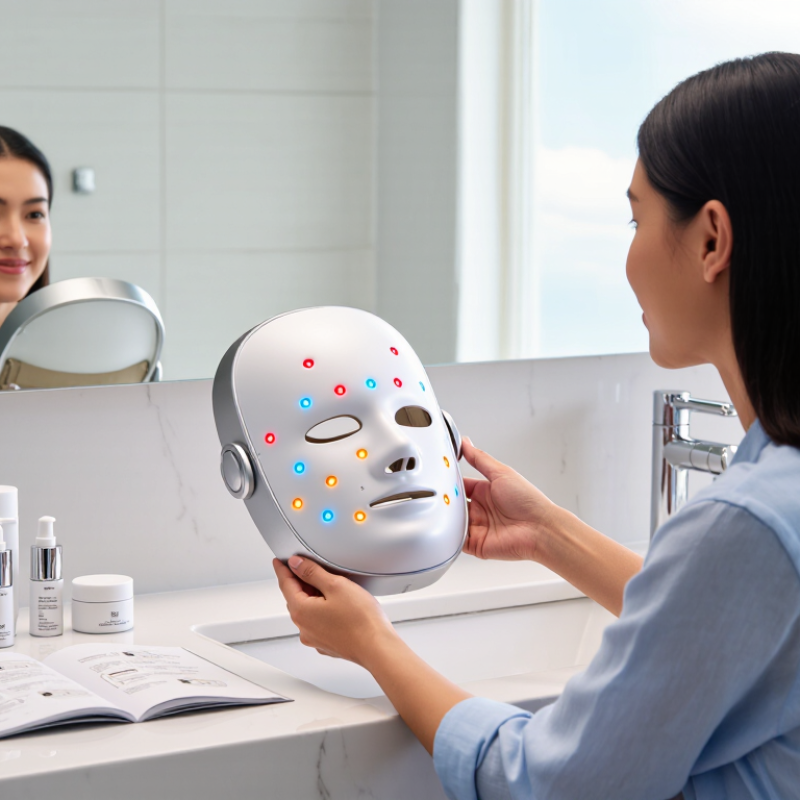
Table of Contents [Hide]
What LED Phototherapy Masks Are and How They Work
An LED phototherapy mask uses small light-emitting diodes to deliver selected wavelengths to the skin. Unlike a heating mask, it is designed to expose the face to light rather than warm it. Red and near-infrared light are commonly used in skincare devices, while blue light is often intended for blemish-prone skin. The exact wavelengths and output vary by device. Light can interact with skin cells, but the biological effects depend on factors such as dose, distance, and session length. It is not magic.
Evidence is still developing, and results can differ between people. Some studies suggest certain light treatments may support skin appearance, but a home mask should not be treated as a cure for acne, wrinkles, or other conditions. That uncertainty matters. Check the device’s wavelength and usage instructions, and use the recommended eye protection. A mask should sit comfortably without pressing hard on the face; stop if you notice pain or unusual irritation. If you have a light-sensitive condition or take medication that increases light sensitivity, ask a qualified health professional before use. Consistency may help, but more sessions are not automatically better.
How to Choose the Best LED Phototherapy Mask in 2026? – What LED Phototherapy Masks Are and How They Work
| Selection factor | What it means | What to check | Practical guidance |
|---|---|---|---|
| How LED phototherapy works | LEDs deliver low-level light to the skin. This is commonly described as photobiomodulation; proposed cellular effects are still being studied. | Look for a clear explanation of the intended use and realistic limits, rather than claims of guaranteed results. | A home mask is not a substitute for diagnosis or treatment from a qualified healthcare professional. |
| Red light | Many devices use red wavelengths in approximately the 630–660 nm range. It is commonly marketed for skin appearance and signs of ageing. | Check the stated wavelength and whether it is supported by device-specific testing. | Results vary, and evidence for consumer devices is not uniform. Avoid assuming that a wavelength alone proves effectiveness. |
| Blue light | Blue-light devices commonly use wavelengths around 405–420 nm and are often intended for acne-prone skin. | Review the intended use, directions, eye-safety instructions, and warnings for photosensitivity. | Blue light may not suit everyone. Consult a clinician if acne is severe, persistent, or scarring. |
| Near-infrared (NIR) | Some masks add near-infrared wavelengths, often in the approximate 800–850 nm range. NIR is not visible to the eye. | Confirm the wavelength and whether the manufacturer provides usable output and safety information. | Do not infer benefit from the presence of NIR alone; evidence and device specifications differ. |
| Wavelength and output details | Wavelength is measured in nanometres (nm). Irradiance is commonly reported in milliwatts per square centimetre (mW/cm²), and dose may be reported in joules per square centimetre (J/cm²). | Prefer transparent specifications and test conditions. A high output number by itself does not establish safety or effectiveness. | Be cautious when key specifications or measurement methods are missing or difficult to verify. |
| Coverage and fit | Mask shape, light placement, and distance from the skin affect which areas receive light and how evenly it is delivered. | Check fit guidance, coverage around the nose and jaw, adjustable straps, and whether the mask stays comfortably in place. | A comfortable, consistent fit is more practical than features that make a device difficult to use regularly. |
| Treatment routine | Recommended session length and frequency vary by device. Home-use instructions should specify both. | Check the timer, automatic shut-off, cleaning instructions, and whether the routine is realistic for you. | Follow the supplied instructions; longer or more frequent sessions are not necessarily better. |
| Eye and skin safety | Light exposure may cause discomfort, and some people or medicines increase sensitivity to light. | Read eye-protection directions and warnings. Check with a healthcare professional if you have an eye condition, a photosensitive condition, or use photosensitising medication. | Stop use and seek appropriate advice if you experience eye pain, significant irritation, or an unexpected skin reaction. |
| Regulatory and evidence checks | Regulatory terms and requirements depend on the country and the device’s intended use. | Verify any clearance or conformity claim with the relevant regulator or official database; do not treat marketing language as proof of approval. | Give more weight to clear documentation, safety instructions, and evidence relevant to the specific device and intended use. |