For dental buyers, bone preservation is not a single product feature. It is a clinical strategy shaped by diagnosis, surgical planning, materials, and follow-up. The aim is practical: retain the patient’s natural bone where possible and support predictable treatment when extraction or implant placement is necessary. Small details matter. Atraumatic extraction, careful socket assessment, and suitable grafting materials can influence the shape of the healing ridge. Yet no material replaces sound clinical judgment.
Periodontist and implant researcher Hom-Lay Wang is often associated with a useful planning principle: “The best implant is the one that is not placed.” The line is a reminder to consider tooth preservation before choosing an implant solution. For buyers comparing bone preservation techniques, it also points to questions worth asking: What evidence supports the method? Which cases suit it? How are complications monitored? Clear answers matter more than broad promises. They help clinicians match products and protocols to patient needs, anatomy, and treatment goals.
This guide examines common approaches, including ridge preservation, guided bone regeneration, and careful management of extraction sites. It also considers material handling, clinical evidence, and practical purchasing criteria. Details vary by case. Results do, too. Even a well-supported technique may not work as expected in every patient, so teams should review current evidence and follow professional guidance. That is the part buyers sometimes overlook.
Bone preservation in implant dentistry means limiting jawbone loss after a tooth is removed. A tooth root helps stimulate the surrounding bone during chewing. After extraction, the ridge can narrow or become shorter as healing progresses. This change may affect implant position, support, and the final crown’s appearance. Small changes matter.
A dentist may use a gentle extraction approach and assess the socket before choosing a preservation method. If the socket walls are thin or damaged, grafting material may help support the healing space. A protective membrane is sometimes used, but not in every case. The goal is not to replace bone instantly. Healing takes months, and results vary.
Planning starts with an examination and suitable imaging. Medical history, infection, gum health, and bite forces can also shape the decision. When comparing treatment plans, ask what bone changes are expected and why a method fits your case. Still, “preservation” can sound more certain than reality; no technique prevents all bone resorption. That deserves a second look.
After a tooth is removed, the surrounding ridge can gradually lose width and height as the body remodels the empty socket. That change is normal. Careful extraction can help limit damage: clinicians may section a tooth or use small instruments to protect the thin bone walls. The aim is not to stop natural healing, but to preserve useful ridge shape.
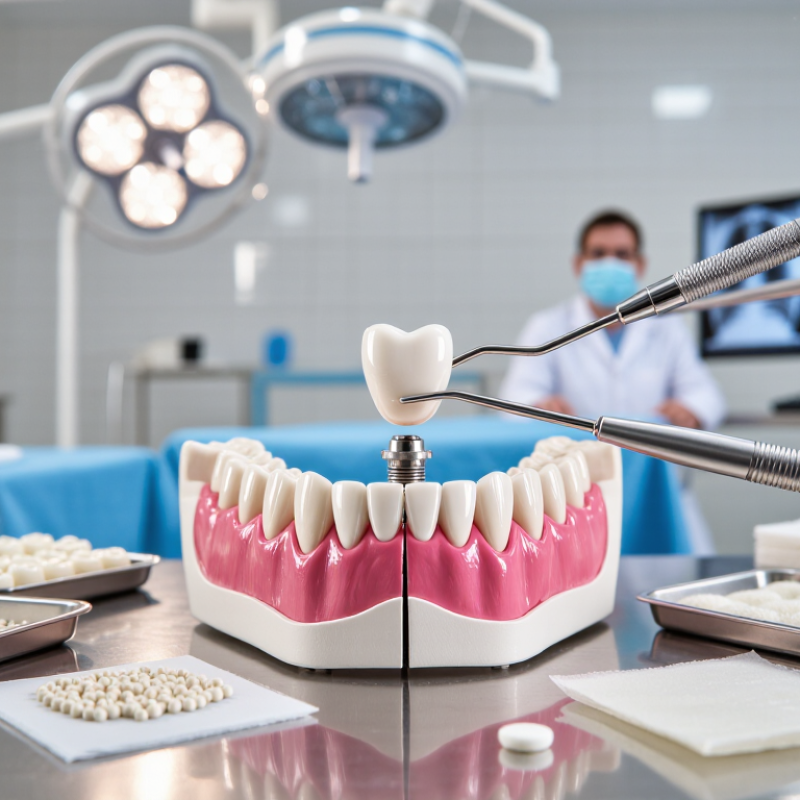
Socket preservation places graft particles into the extraction site after cleaning. The particles act as a scaffold while new bone develops; they do not instantly become living bone. A membrane may cover the graft to help keep soft tissue from growing into the space too quickly. Think scaffold, not replacement. The site is then allowed to heal, with follow-up checks for tissue closure and signs of infection. Results vary, and grafting is not needed for every extraction.
For dental buyers, technique and case selection matter as much as the material itself. Compare handling requirements, particle size, barrier options, and clear clinical instructions. Ask how the protocol fits different socket conditions and how healing is monitored. A neat package cannot make a poor indication suitable. Evidence and consistent training deserve close review, though real-world healing can still differ from study results.
For dental buyers, graft selection begins with the defect, not a product label. Autogenous bone comes from the patient and can support healing, but harvesting adds a second surgical site. Donor-derived allografts avoid that step. Animal-derived xenografts and synthetic materials offer other handling and resorption profiles. Each option has trade-offs.
Fit matters more than labels. Particle size, packaging, sterilization records, and clear instructions affect daily use. A small contained socket may need a different graft form than a wide ridge defect. Clinicians also consider the patient’s health, anatomy, and planned restoration. Buyers should review technical documentation and verify that material origin and processing are clearly stated. Ask about storage conditions, shelf life, and traceability.
Membranes help maintain space and limit soft-tissue migration while the site heals. Resorbable collagen membranes avoid a removal procedure in many cases, though their persistence varies. Non-resorbable membranes, including PTFE types, can provide longer-term space maintenance but may require removal. No membrane suits every site. Handling matters: a membrane that tears during placement can complicate an otherwise straightforward procedure. I would not treat a longer resorption time as automatically better; clinical judgment and defect shape still matter. The evidence is useful, but patient outcomes can vary.
| Technique | Typical clinical use | Common graft materials | Membrane commonly used | Key selection considerations |
|---|---|---|---|---|
| Alveolar ridge preservation | Filling an extraction socket to help limit ridge volume changes before possible implant placement. | Particulate allograft, xenograft, or synthetic calcium-phosphate graft; autogenous bone may be used in selected cases. | Resorbable collagen membrane or collagen plug; a membrane may be omitted in selected contained sockets. | Consider socket-wall integrity, soft-tissue closure, particle handling, and the intended timing of implant placement. Preservation does not prevent all post-extraction remodeling. |
| Guided bone regeneration (GBR) | Localized horizontal or vertical augmentation around an implant or within a deficient ridge. | Autogenous bone, allograft, xenograft, or alloplast; clinicians may combine materials to balance handling and space maintenance. | Resorbable collagen for many contained defects; non-resorbable e-PTFE or d-PTFE, sometimes reinforced, when prolonged barrier support is needed. | Membrane stability, defect size, soft-tissue tension, exposure risk, and the need for a second procedure are important. Non-resorbable membranes generally require removal. |
| Lateral ridge augmentation | Increasing ridge width where the existing bone is insufficient for the planned implant position. | Particulate autogenous bone, often used alone or mixed with an allograft, xenograft, or alloplast. | Collagen membrane for selected defects; reinforced membranes or barrier-supported approaches may be considered when greater space maintenance is needed. | Assess defect morphology, available soft tissue, graft containment, and fixation requirements. Outcomes depend on case selection and surgical technique. |
| Sinus floor elevation | Creating additional bone volume in the posterior maxilla when sinus anatomy limits implant placement. | Autogenous bone, allograft, xenograft, or alloplast; material choice varies with the approach and clinical plan. | A resorbable collagen membrane may be used to cover a lateral window; a separate membrane is not required in every approach. | Review sinus anatomy and membrane integrity. Graft selection, implant timing, and healing expectations should be determined by the treating clinician. |
| Periodontal intrabony defect grafting | Regenerative treatment of selected periodontal defects after infection and inflammation have been controlled. | Allograft, xenograft, alloplast, or autogenous bone, selected according to defect configuration and treatment plan. | Resorbable collagen membrane is commonly used for guided tissue regeneration; some cases use graft material without a membrane. | Defect containment, oral hygiene, periodontal stability, and postoperative maintenance affect suitability and prognosis. |
Material guide: Autogenous graft is harvested from the patient; allograft is human donor-derived; xenograft is animal-derived; and alloplast is synthetic. Resorbable membranes are typically collagen-based, while non-resorbable barriers include PTFE materials. Availability, permitted indications, and regulatory requirements vary by market. Selection should be made by a qualified dental professional based on the patient, defect, and applicable local regulations.
Dental buyers comparing bone-preservation products should look beyond particle size and price. Check the material source, composition, sterilization method, packaging integrity, and storage requirements. A graft that handles predictably in a damp surgical field may be more useful than one with an impressive catalogue description. Ask how the material is intended to behave over time, and whether the instructions clearly describe its clinical use. Details matter.
Clinical evidence deserves the same careful review. Look for human studies that match the intended procedure, such as socket preservation, and note the number of patients, follow-up period, and measured outcomes. A small study with short follow-up may be informative, but it cannot answer every question. Compare reported ridge-width changes, complications, and need for additional procedures, rather than relying on a single headline result. Check whether researchers disclose funding and whether findings appear across independent studies. Not every paper is equal.
Buyers can also request current technical documents, evidence summaries, and clear guidance for handling or traceability. Compare like with like: different defects, surgical techniques, and follow-up schedules can make results difficult to interpret. A spreadsheet helps, though it will not replace clinical judgment. If evidence is limited or inconsistent, record that uncertainty instead of treating it as proof of failure or success.
Mean dimensional changes reported after unassisted socket healing
How to interpret: These values describe tissue changes in extraction sites healing without ridge preservation; they are a clinical benchmark, not a head-to-head comparison of graft products. When evaluating products, buyers should compare study design, follow-up period, measurement site, and patient population.
Source: Tan WL et al. “A systematic review of post-extractional alveolar hard and soft tissue dimensional changes in humans.” Clinical Oral Implants Research. 2012;23(Suppl 5):1–21.
For dental buyers assessing Chinese suppliers of bone-preservation materials, verify the product’s registration, manufacturing site, and intended clinical use. Request a current ISO 13485 certificate, then confirm its scope covers the actual production site and device category. The ISO Survey 2023 recorded more than 31,000 ISO 13485 certificates worldwide. Certification is useful, but it does not establish the quality of every batch.
Review technical files against ISO 10993 for biological evaluation and ISO 14971 for risk management. Ask for batch-specific certificates of analysis, sterilization validation, endotoxin results where applicable, and records linking raw materials to finished lots. Inspect a sample package: check the seal, labeling, expiry date, and whether the graft material’s particle-size range matches its specification. Small details count.
Clinical claims also need careful scrutiny. A Cochrane review of 16 trials covering 524 extraction sites rated evidence for alveolar ridge preservation as low or very low certainty. That uncertainty makes unsupported promises a warning sign. Compare the supplier’s clinical evidence with the exact material and procedure being sold; similar-looking granules are not automatically interchangeable. One gap remains: a polished audit file cannot replace independent testing or consistent incoming inspection.
Copyright © 2021 United Orthopedic Corporation All Rights Reserved.
Necessary cookies are absolutely essential for the website to function properly. This category only includes cookies that ensures basic functionalities and security features of the website. These cookies do not store any personal information.
Any cookies that may not be particularly necessary for the website to function and is used specifically to collect user personal data via analytics, ads, other embedded contents are termed as non-necessary cookies. It is mandatory to procure user consent prior to running these cookies on your website.